
How we address the challenge
Nature restoration decisions involve complex interactions between ecosystems, economies and people. Understanding these interactions requires more than a single model or indicator. NatuRISE brings together evidence, modelling, valuation and stakeholder knowledge to develop a more complete picture of the benefits, costs and wider impacts of nature restoration.
The project will connect scientific analysis with the needs of those making and implementing restoration decisions — from local and regional authorities to national and EU policy makers.
“Build better evidence. Connect the pieces. Work with those who will use it. Turn knowledge into practical decision support.”
1
NatuRISE will gather, synthesise and generate evidence on the socio-economic impacts of nature restoration, including benefits and costs that are often difficult to capture.
2
Enhanced models and assessment methods will examine how restoration affects ecosystems, economic activities, territories and people — across different spatial and time scales.
3
Policy makers, public authorities, land managers and other stakeholders will help shape the questions, indicators and applications so that the research addresses real decision needs.
4
The project will bring evidence and analysis together through datasets, assessment methods, models, knowledge products and a decision-support tool.
5
The resulting evidence and tools will help decision-makers assess options, understand trade-offs and identify restoration measures that can deliver strong environmental and socio-economic benefits.
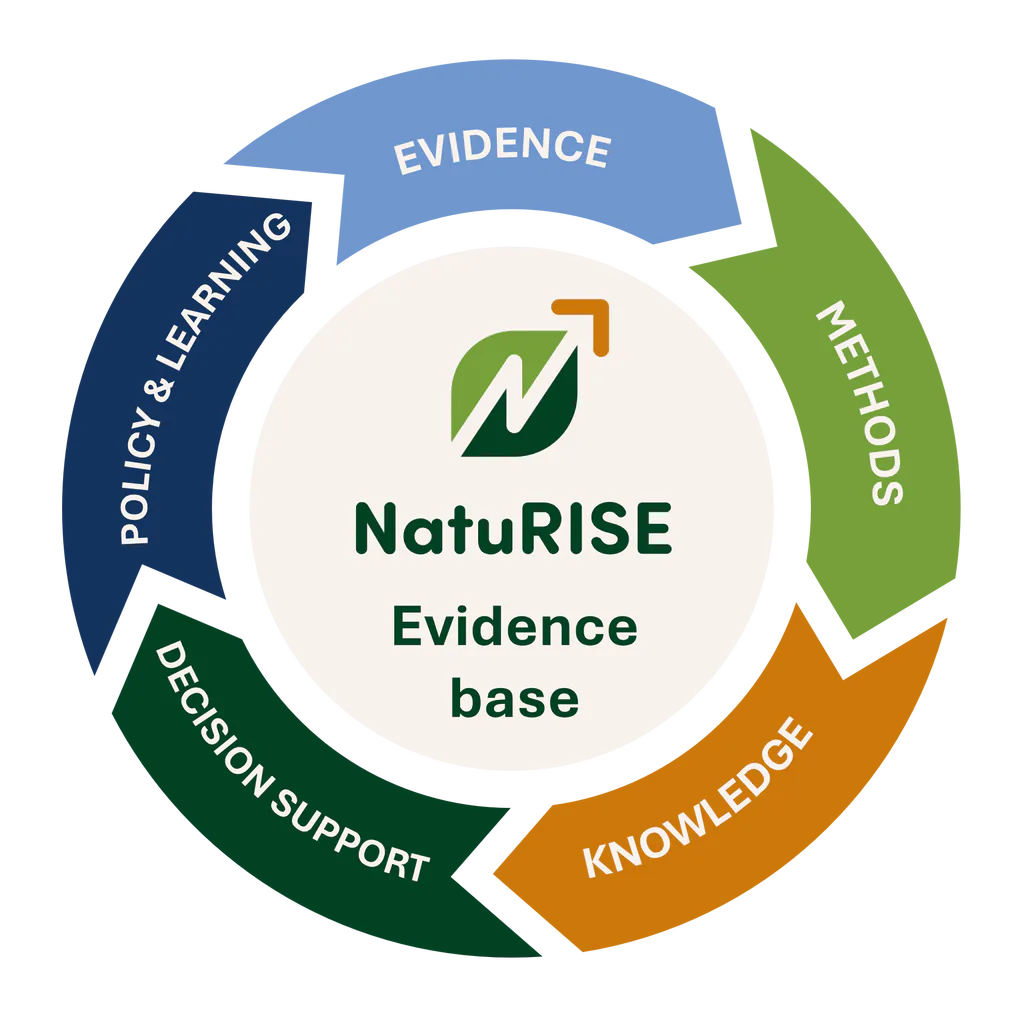
NatuRISE will develop an integrated approach to understanding the full range of impacts associated with nature restoration.
strengthen the evidence base on restoration benefits and costs
integrate ecological, economic and social dimensions
test approaches in four real-world case studies
synthesise existing scientific knowledge and identify evidence gaps
examine impacts across territories, sectors and population groups
co-create and evaluate solutions with stakeholders
develop and enhance models for assessing restoration impacts
assess monetary, non-monetary and plural values
translate findings into accessible decision-support tools & knowledge products
Multi-Level Engagement Framework
NatuRISE combines research and innovation with stakeholder engagement.
The project operates across several levels:
EU-wide evidence and modelling will help identify broader patterns, feedbacks and policy implications.
Assessments explore how restoration policies and measures can affect national economies, sectors and policy objectives.
4 case studies examine restoration choices in real-world contexts, connecting ecological changes with local economic and social conditions.
Stakeholder engagement will provide practical knowledge and feedback, helping connect scientific assessment with implementation realities.
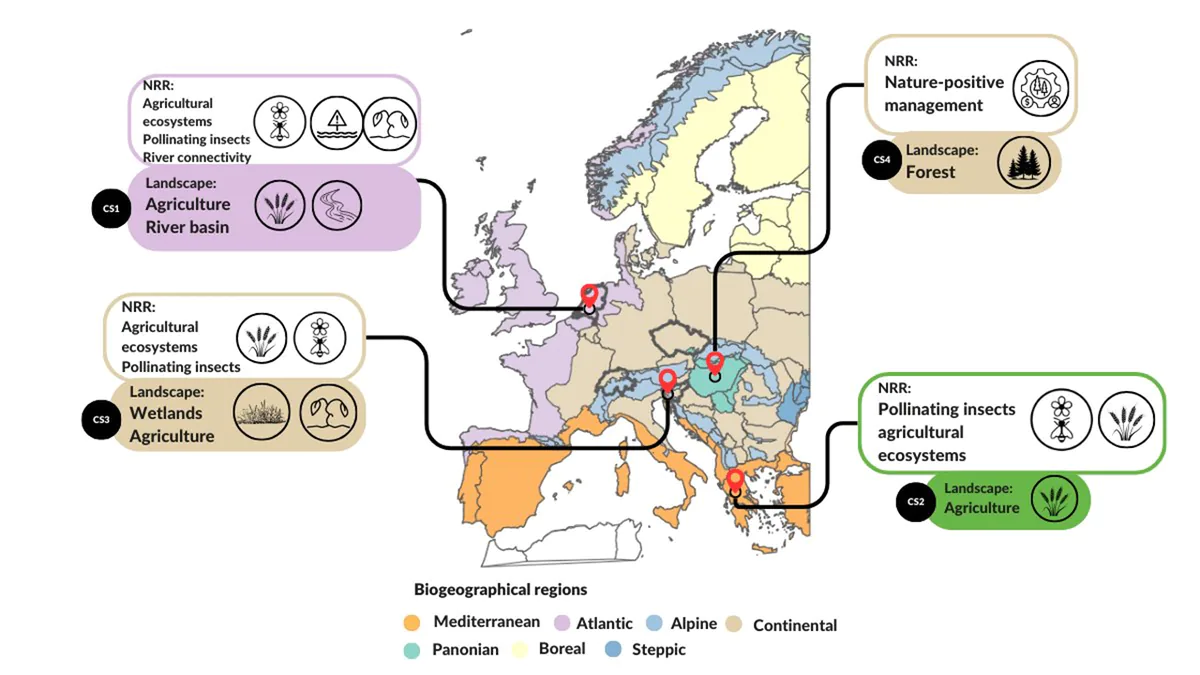
Four case studies
The project’s four case studies provide settings in which methods and models can be applied, tested and refined.
They cover agricultural, forest and freshwater ecosystems and involve stakeholders with direct knowledge of restoration challenges and opportunities.
The case studies will help NatuRISE explore questions such as:
Which restoration measures are relevant in a particular context?
How might different groups and territories be affected?
How can complex assessments be translated into practical choices?
What benefits and costs could they generate?
What constraints could influence implementation?
The aim is to co-create and evaluate approaches in contexts where restoration decisions actually have to be made.
NatuRISE brings together methods from environmental economics, agricultural and land-use modelling, ecosystem service assessment, spatial analysis, behavioural research and social science. No single method can capture all dimensions of nature restoration. The project therefore combines complementary approaches to assess:
How restoration changes ecosystems, biodiversity and ecosystem services.
How restoration affects production, costs, incomes, employment and wider economic activity.
How restoration can influence health, wellbeing, recreation, perceptions and societal acceptance.
How benefits and costs vary between territories, sectors and population groups.
How impacts develop and change over the short, medium and long term.
How changes in one location or sector can affect other parts of the economy, land-use system or society.
A central element of NatuRISE is a broader understanding of value. Some restoration effects can be expressed in monetary terms. Others are better represented through physical indicators, qualitative evidence or alternative valuation approaches. NatuRISE will therefore combine:
Assessing benefits and costs where appropriate.
Comparing options across multiple objectives and indicators.
Capturing benefits such as health, wellbeing, recreation and cultural values.
Recognising that people can value nature in different ways.
NatuRISE will build on established datasets, models and scientific knowledge while developing new data and methodological capabilities where important gaps remain. The project will work with:
Including information on restoration benefits, costs, ecosystem services and distributional impacts.
Systematically bringing together existing research to identify patterns, evidence gaps and relevant effect sizes.
Assessing how restoration interacts with agriculture, forestry, markets, employment and the wider economy.
Examining where impacts occur and how restoration changes land-use patterns and territorial outcomes.
Connecting ecological changes with benefits such as pollination, water regulation, recreation and wellbeing.
Translating complex assessments into information that policy makers and implementers can use.

A key feature of NatuRISE is to connect complementary models so that information can flow between them.
This helps capture feedbacks that may otherwise remain outside individual assessments.
Stakeholder engagement is part of how the project will develop and test its research and tools.
The project uses different levels of engagement for different audiences.
National and EU-level policy makers will help identify relevant policy questions, targets, measures and indicators and provide feedback on emerging findings.
Stakeholders involved in the four case studies will work with the project to explore restoration priorities, test approaches and assess whether outputs are useful in real decision contexts.
The project will engage researchers, NGOs, practitioners, sister projects and wider networks through workshops, learning activities, conferences, webinars and other exchanges.
The project will create opportunities for stakeholders to:
What questions need answering?
Which measures, indicators and impacts matter?
Do the assessments make sense in practice?
What could different restoration choices mean?
What would make them more useful and accessible?
This iterative process will help ensure that NatuRISE outputs are scientifically robust, relevant to policy needs and usable in practice.
The ultimate purpose of NatuRISE is not simply to produce new datasets, models or publications. It is to help turn complex evidence into better-informed restoration decisions. The project will translate research into outputs such as:
1
What could restoration change?
2
How do different measures and locations compare?
3
Where could action generate the greatest overall benefits?
4
What needs to be considered for implementation?
The NatuRISE decision-support approach will bring together monetary and non-monetary evidence to help users explore restoration options.
Benefits and costs
Territorial impacts
Territorial impacts
Trade-offs and synergies
Distributional effects
Alternative restoration options
The aim is to give decision-makers better evidence with which to make their own informed choices.