
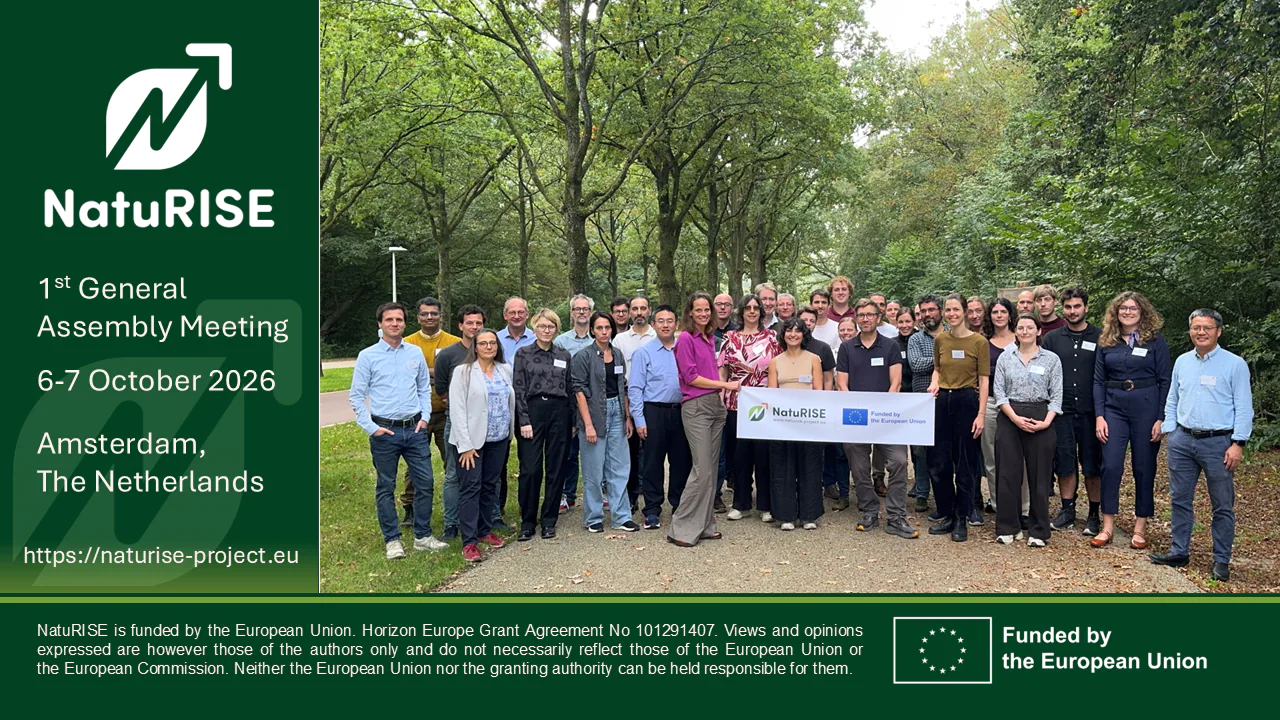
The NatuRISE consortium met in Amsterdam on 6–7 October 2026 to connect its research plans and establish how integrated evidence can help decision-makers understand the wider impacts of nature restoration.
Nature restoration can deliver benefits for biodiversity, climate resilience and human wellbeing. Yet deciding which measures to implement, where to prioritise them and how to finance them requires a broader understanding of their costs, benefits and distributional effects. What works in one landscape may have different implications in another, and benefits for nature and society need to be considered alongside the practical and economic consequences for the people managing the land.
These questions are central to NatuRISE, a four-year Horizon Europe project working to strengthen the evidence available for nature restoration decisions. At its Kick-off and First General Assembly Meeting in Amsterdam on 6–7 October 2026, the consortium brought together its research and implementation plans, exploring how ecological evidence, socioeconomic analysis, modelling and stakeholder knowledge can be combined to support better-informed decisions.
Understanding the full impacts of restoration
A restoration measure can affect more than the ecosystem it directly targets. Changes in land management may influence agricultural production, farm income, employment, ecosystem services and the distribution of costs and benefits across communities. Some effects may emerge locally, while others may be felt across regions or through wider economic and environmental interactions.
NatuRISE aims to make these connections more visible. Its approach combines evidence synthesis and data development with ecological, land-use and socioeconomic modelling, plural valuation and stakeholder engagement. The project will use these complementary methods to assess restoration measures across different sectors, actors, spatial scales and time horizons.
The goal is to develop evidence that helps users compare restoration options, understand trade-offs and synergies, and consider how outcomes may differ between places and groups. This is relevant to public authorities preparing and implementing restoration plans, as well as farmers, forest managers, researchers and other organisations involved in planning, financing or delivering restoration.
Four case studies connect assessment with real-world decisions
The Amsterdam meeting introduced four territorial case-study contributions spanning wetland and meadow restoration, agricultural practices, river restoration and forest management. Each addresses a different set of ecological, economic and institutional conditions.
- Wetland and meadow restoration in Slovenia: The Ljubljansko barje case examines hydrological restoration, habitat management and biodiversity, alongside the implications of less-intensive management for farmers and the local landscape.
- Agricultural eco-schemes in Greece: This case will explore how restoration-related agricultural practices and policy incentives may affect farm income, employment and regional economic activity, and how stakeholders can help assess alternative scenarios.
- River restoration in the Netherlands: The Meuse watershed case will investigate landscape values, restoration options and the distribution of ecological and socioeconomic impacts, including how local perspectives can inform spatial planning.
- Forest restoration in Hungary: The case will examine closer-to-nature forest management, considering its potential costs and benefits alongside biodiversity, climate resilience and the wider services provided by forests.
Together, the cases offer different perspectives on a common challenge: understanding how restoration choices interact with land management, local livelihoods, environmental conditions and public policy. Stakeholder engagement will be important for identifying relevant questions, interpreting results and ensuring that the assessment reflects the circumstances in which decisions are made.
Connecting local evidence with EU-level assessment
The case studies form part of a wider assessment framework that includes models of economic activity, agricultural production, land-use change, forestry and ecosystem services. The consortium discussed how these approaches can complement one another and contribute to an integrated assessment of restoration impacts.
Connecting the models requires careful attention to differences in spatial scale, assumptions, data and the way restoration measures are represented. The assessment also needs to distinguish the costs of implementing a measure from the economic opportunities that may be forgone, and to account for interactions such as changes in production or prices beyond the area where restoration takes place.
These methodological questions are important because decision-makers need to understand not only the expected effects within a restoration site, but also how interventions may influence wider environmental and socioeconomic systems. Further coordination between the modelling teams and case-study partners will help establish how evidence can be combined and interpreted consistently.
Making the evidence useful to decision-makers
Scientific assessment can support decisions only when the resulting knowledge is accessible and relevant to the people who need it. NatuRISE therefore combines its research activities with stakeholder engagement and the development of a decision-support tool intended to help users compare restoration options and examine their wider implications.
The project will consider how different forms of evidence can support different decisions, from EU-level policy assessment to choices made by national authorities and restoration implementers. Stakeholder knowledge will contribute to the development and interpretation of scenarios, while the assessment framework will help make ecological and socioeconomic effects more transparent.
The meeting also addressed how the project will communicate findings, share research outputs and identify opportunities for their use in policy, practice and further research. This work will continue alongside the research itself, helping the consortium identify relevant audiences and translate technical results into formats that users can understand and apply.
Building an integrated evidence base for nature restoration
The kick-off meeting established a shared starting point for the consortium's scientific and operational work. The next stages will involve developing the data, methods, case studies and modelling approaches, while strengthening coordination across work packages and engaging with the stakeholders whose decisions influence restoration outcomes.
By connecting ecological evidence with economic analysis, societal values and practical experience, NatuRISE aims to improve understanding of the wider consequences of restoration choices. The intended contribution is a more comprehensive and transparent evidence base to help policymakers, land managers and other stakeholders compare options, recognise trade-offs and identify approaches that deliver benefits for nature and society.